21st September 2026
What Would a 0.5% Interest Rate Rise Mean for Vehicle Finance?
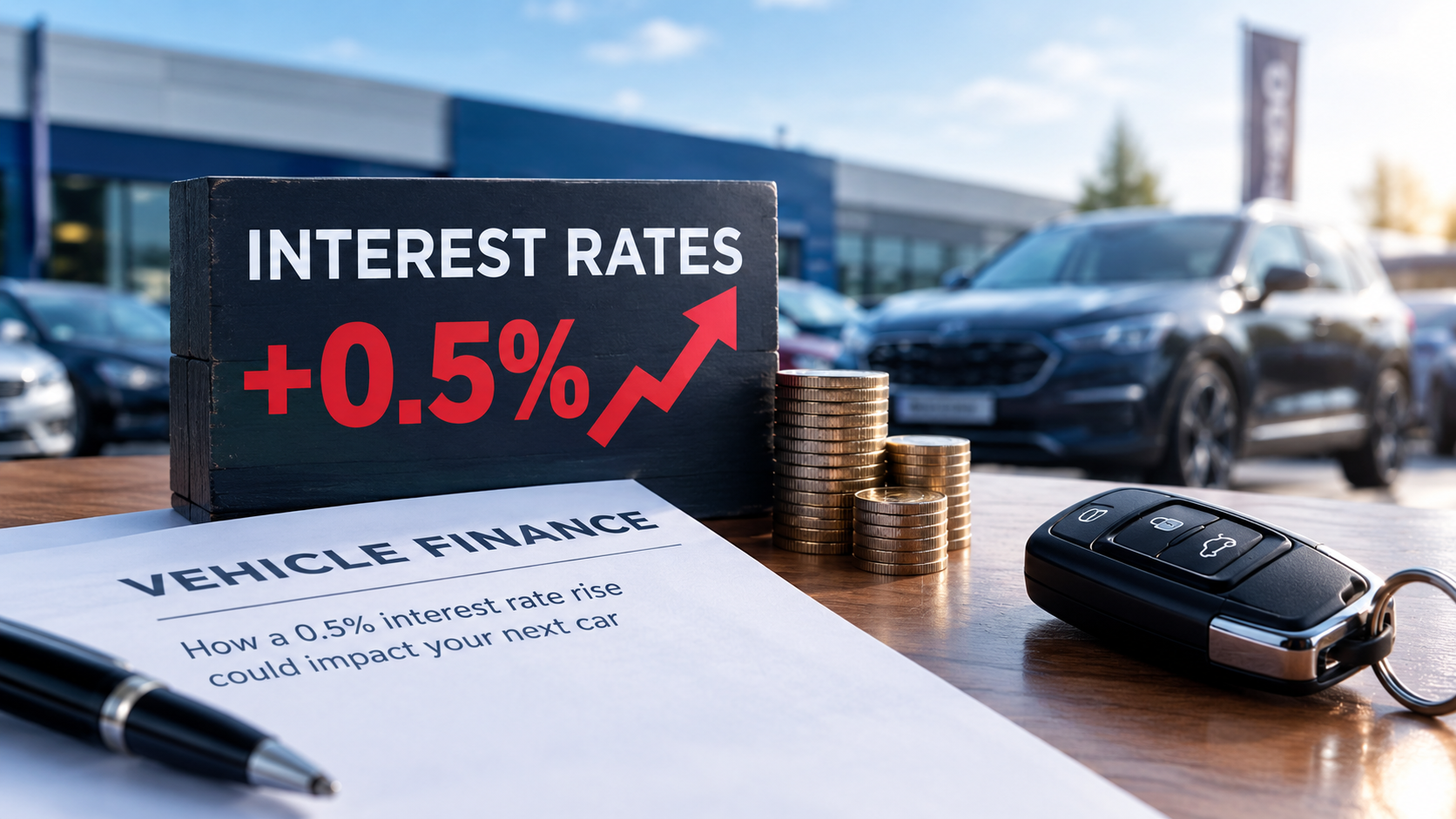
Could a 0.5% increase make financing your next car or van more expensive? When the Bank of England changes interest rates, most people immediately think about mortgages. But there is another area where interest rates can have a significant impact -vehicle finance.
Whether you're financing a £20,000 family car, a £40,000 premium vehicle, a £50,000 commercial van or an entire business fleet, the cost of borrowing is an important part of the overall price you pay.
With Bank Rate currently at 3.75%, the possibility of further increases remains an important consideration for consumers and businesses. A hypothetical 0.5 percentage point increase would take Bank Rate to 4.25%. At first glance, 0.5% might not sound like much. But when you're borrowing tens of thousands of pounds over several years, even relatively small changes in the cost of finance can affect monthly payments, total interest and ultimately the affordability of your next vehicle.
So what could a 0.5% increase actually mean for vehicle finance?
A 0.5% increase in Bank Rate would not automatically mean vehicle finance rates increase by exactly 0.5%. However, if wider borrowing costs increase, lenders may adjust the rates available on new finance agreements. This could mean:
- Higher monthly vehicle finance payments
- Increased total interest payable
- Higher costs for business vehicle finance
- Greater costs when financing multiple vehicles
- More importance placed on deposits and finance terms
- Consumers becoming more focused on vehicle affordability
- Businesses reviewing fleet replacement plans
- Greater demand for competitive finance options
- More importance placed on the vehicle's total cost of ownership
The actual impact will depend on the lender, finance product, customer circumstances, deposit, term and wider financial market.
Why Do Interest Rates Matter to Vehicle Finance?
When you finance a vehicle, you're effectively borrowing money to purchase it. The lender provides the funds to purchase the vehicle, and you repay that amount over an agreed period, alongside the applicable interest and charges. This means the cost of borrowing is directly connected to the overall cost of financing the vehicle. If the cost of borrowing increases across the financial system, lenders may face higher funding costs and could subsequently adjust the rates they offer customers.
It doesn't mean every finance agreement changes immediately.
It does mean that anyone looking to finance a vehicle should pay attention to the actual rate being offered, rather than simply looking at the monthly payment.
1. A Small Rate Increase Can Add Up Over Time
The biggest misconception about interest rates is that a small percentage change must have a small financial impact. The reality depends on how much you're borrowing and how long you're borrowing it for. Consider a customer financing a £30,000 vehicle.
The difference between two finance rates may appear relatively small when expressed as a percentage. However, over a three, four or five-year agreement, that difference can contribute to a meaningful change in the total amount paid. This is particularly important when financing more expensive vehicles. A £2,000 change in the total cost of finance might not sound significant when you're buying a £60,000 vehicle, but it is still £2,000 that could have been retained in your bank account or invested elsewhere.
The longer the finance agreement and the larger the amount borrowed, the more important the interest rate becomes.
2. Your Monthly Payment Could Become More Important
For many vehicle buyers, the first question is: “How much will it cost me per month?”
Monthly affordability is obviously important, but it shouldn't be the only consideration. A finance agreement can be structured in different ways, with the deposit, term, mileage, final payment and interest rate all affecting the monthly figure. A lower monthly payment can sometimes be achieved by extending the finance term.
But that doesn't necessarily mean the vehicle is cheaper to finance overall. This is why customers should consider:
Monthly payment + interest rate + total amount payable + agreement length.
Looking at all four provides a much clearer picture of the true cost of vehicle finance.
3. Vehicle Finance Could Become More Expensive for Consumers
For private customers, higher borrowing costs could influence the type of vehicle they choose. Someone who originally planned to finance a £40,000 vehicle might reconsider and look at a £30,000 alternative. Another customer may choose to increase their deposit.
Others might decide to purchase a slightly older vehicle to reduce the amount they need to borrow. This doesn't necessarily mean people will stop buying cars.
Instead, higher finance costs can change what people buy, how much they borrow and how they structure the purchase. That makes finding the right vehicle at the right price even more important.
4. Premium and Prestige Vehicles Could Be Particularly Sensitive
The impact becomes more noticeable as the amount being financed increases. Consider someone financing a £70,000 prestige vehicle. A small change in the cost of finance could have a larger monetary impact than it would on a £15,000 vehicle simply because there is more money being borrowed.
For customers financing premium, luxury or performance vehicles, it therefore becomes particularly important to consider the entire finance structure. The cheapest vehicle isn't necessarily the best option. And the most expensive vehicle isn't necessarily unaffordable.
The key is finding a combination of:
Vehicle + deposit + finance structure + monthly payment + total cost
5. What About Van Finance?
Vehicle finance isn't just about private cars. For thousands of UK businesses, vans are essential to day-to-day operations.
Electricians, plumbers, builders, landscapers, couriers, engineers and countless other businesses rely on commercial vehicles to generate revenue. For these businesses, van finance is often an important part of managing cash flow.
A business may need to finance a £25,000 van today rather than spending £25,000 of its available cash. If finance rates increase, the cost of that decision could also increase. But using finance can still make sense because retaining cash within the business can be important for:
- Payroll
- Stock
- Marketing
- Expansion
- Unexpected expenses
- Tax
- Working capital
The decision isn't simply about finding the lowest interest rate. It's about finding the right balance between vehicle cost, finance cost and business cash flow.
6. Business Vehicle Finance Could Feel the Impact Even More
Businesses operating multiple vehicles can be exposed to interest rate changes across their entire fleet. Imagine a company financing 10 vehicles at £30,000 each. That's £300,000 of vehicle funding. A change in finance costs across the fleet can therefore become much more significant than it would for a single vehicle.
This is why businesses should look at fleet finance as part of their wider financial planning. Before replacing vehicles, businesses should consider:
- How many vehicles are genuinely required?
- Which vehicles generate revenue?
- How long should each vehicle be retained?
- What finance structure works best?
- What are the expected running costs?
- What will the vehicles be worth when replaced?
- Should vehicles be purchased, leased or financed?
- How will the decision affect cash flow?
7. Fleet Finance Isn't Just About the Interest Rate
For businesses, focusing exclusively on the interest rate can be a mistake. The cheapest finance rate doesn't necessarily produce the lowest overall fleet cost. For example, a business could finance a cheaper vehicle but then experience higher:
- Fuel costs
- Servicing costs
- Repair bills
- Downtime
- Insurance costs
- Depreciation
Conversely, a slightly more expensive vehicle could potentially deliver better reliability, fuel efficiency or resale value. This is why businesses should consider the total cost of ownership.
Total Cost of Ownership: Finance + depreciation + fuel + insurance + servicing + repairs + tyres + downtime
The finance rate is only one piece of the puzzle.
8. Could Higher Interest Rates Change What People Buy?
Potentially. When vehicle finance becomes more expensive, customers may become more price-conscious. Instead of simply deciding: “I want this car.” the decision may become: “Which car gives me the best overall value within my budget?”
That could lead customers to consider:
- Used vehicles
- Nearly-new vehicles
- Smaller engines
- More economical vehicles
- Longer-term ownership
- Larger deposits
- Different finance products
- Vehicles with stronger resale values
For businesses, the same principle applies to vans and commercial vehicles.
9. Used Vehicles Could Become More Attractive
One possible consequence of higher finance costs is greater interest in used vehicles. A customer who was originally looking at a £35,000 new car may decide that a £25,000 or £28,000 used vehicle provides better financial value. This can reduce the amount that needs to be borrowed. It can also potentially reduce depreciation, although the actual financial outcome depends on the individual vehicle and market.
The important point is that vehicle sourcing becomes increasingly valuable when customers have a specific budget to work within. Instead of being limited to whatever is available at one dealership, buyers can search across a much wider market for vehicles that meet their exact requirements.
10. Why Vehicle Sourcing Could Become More Important
When finance costs are higher, paying too much for the vehicle itself becomes even more important to avoid. If you're borrowing money to purchase a vehicle, every pound saved on the purchase price can potentially reduce the amount that needs to be financed.
This is where vehicle sourcing can make a difference. A professional sourcing service can search the market for vehicles based on:
- Budget
- Specification
- Age
- Mileage
- Condition
- Vehicle type
- Intended use
- Finance requirements
- Business requirements
Rather than starting with: “What does this dealership have?” the process starts with: “What vehicle actually meets the customer's requirements?”
11. Should You Delay Buying a Vehicle If Rates Rise?
Not necessarily. This is one of the most important points for anyone considering vehicle finance. A higher Bank Rate doesn't automatically mean you should delay buying a vehicle. For many people, the vehicle is essential.
A business may need a replacement van because the existing one is unreliable. A growing company may need another vehicle to employ another member of staff. A family may need a larger car. A customer may simply have reached the point where their existing vehicle needs replacing.
In these situations, waiting for interest rates to change could potentially create other costs.
For a business, keeping an unreliable van on the road could mean increased repairs and lost working time. The important question is therefore not: “Should I buy a vehicle because interest rates are low?” It is: “Does buying this vehicle make financial sense for me or my business?”
12. What Should You Look For When Comparing Vehicle Finance?
If you're considering vehicle finance in a higher-interest-rate environment, don't compare agreements based solely on the monthly payment. Look at:
- Interest Rate - What rate is being offered and how does it compare with alternative options?
- Deposit - How much are you putting into the vehicle upfront?
- Finance Term - How long will you be making payments?
- Total Amount Payable - What will the vehicle ultimately cost once the finance agreement is completed?
- Final Payment - If the agreement includes a final payment, understand exactly what it means for you.
- Vehicle Value - How is the vehicle expected to perform in terms of depreciation and resale?
- Running Costs - Fuel, insurance, servicing, tyres and repairs all contribute to the real cost of ownership.
What Could a 0.5% Rise Mean for Businesses?
For businesses, the impact depends heavily on the size and structure of the fleet. A business financing one van is in a very different position to a company financing 50 vehicles. For larger fleets, even small changes in financing costs can potentially have a material effect when multiplied across multiple vehicles.
This makes fleet finance planning increasingly important. Businesses should consider whether vehicles should be:
- Purchased outright
- Financed through Hire Purchase
- Funded through another finance structure
- Leased
- Replaced
- Retained for longer
There is no universal solution. The right approach depends on the business, the vehicles and how they are used.
The Opportunity: Better Vehicle Buying Decisions
Higher interest rates can make vehicle finance more expensive. But they can also encourage customers and businesses to become more disciplined about how they buy vehicles. Instead of focusing purely on: “What is the monthly payment?” buyers can look at the bigger picture: “What vehicle am I buying, how much am I borrowing, what will it cost me to run, and what will it be worth when I'm finished with it?”
That approach can help consumers and businesses make more informed vehicle finance decisions regardless of where interest rates move next.
Find & Finance: More Than Just Vehicle Finance
At Find & Finance, we believe financing a vehicle shouldn't simply be about finding a lender and getting a monthly payment. It's about finding the right vehicle and the right financial solution.
Our Fully Managed Motoring approach combines vehicle sourcing and finance with inspection, preparation and delivery. But the relationship doesn't stop when the vehicle arrives.
We can continue supporting customers throughout the vehicle's lifecycle, including:
- MOT
- Servicing
- Repairs
- Bodywork
- Warranty claims
- Maintenance
- Resale
Helping maximise the vehicle's future value
For businesses, this approach can also extend to commercial vehicles and fleet requirements. The aim is simple: Find the right vehicle. Finance it correctly. Look after it throughout its lifecycle.
Final Thoughts
A 0.5% increase in Bank Rate may sound relatively small. But when you're financing a £20,000 car, a £40,000 van or a fleet worth hundreds of thousands of pounds, the cost of borrowing deserves serious consideration. A rate increase would not automatically mean every vehicle finance agreement becomes 0.5% more expensive. However, changes in wider borrowing conditions can influence the rates lenders offer and the overall cost of financing a vehicle.
For consumers, this makes comparing finance options and understanding the total cost of a vehicle increasingly important.
For businesses, it makes effective fleet planning, vehicle sourcing and total cost-of-ownership analysis even more valuable.
Ultimately, the goal shouldn't simply be to find the lowest monthly payment. It should be to find the right vehicle, at the right price, with a finance solution that works for your circumstances. And when the cost of borrowing changes, making the right decision at the start can make a significant difference over the entire life of the vehicle.
Thinking About Financing Your Next Vehicle?
Whether you're looking for a personal car, a commercial van or vehicles for an entire business fleet, Find & Finance can help.
From vehicle sourcing and finance through to inspection, preparation, delivery and ongoing aftercare, our Fully Managed Motoring service is designed to take the complexity out of vehicle ownership.
Your vehicle journey doesn't end when the keys are handed over — that's where ours continues.
Call: 0333 006 3825
Email: sales@findandfinance.co.uk
Website: www.findandfinance.co.uk
Your next vehicle doesn't have to be the one sitting on the nearest forecourt. It could be the one we find for you.
Stay ahead of the latest automotive news, vehicle buying advice and market insights by subscribing to our newsletter here