1st October 2026
Andy Burnham's Vehicle Policies: What Could They Mean for Drivers and Businesses?
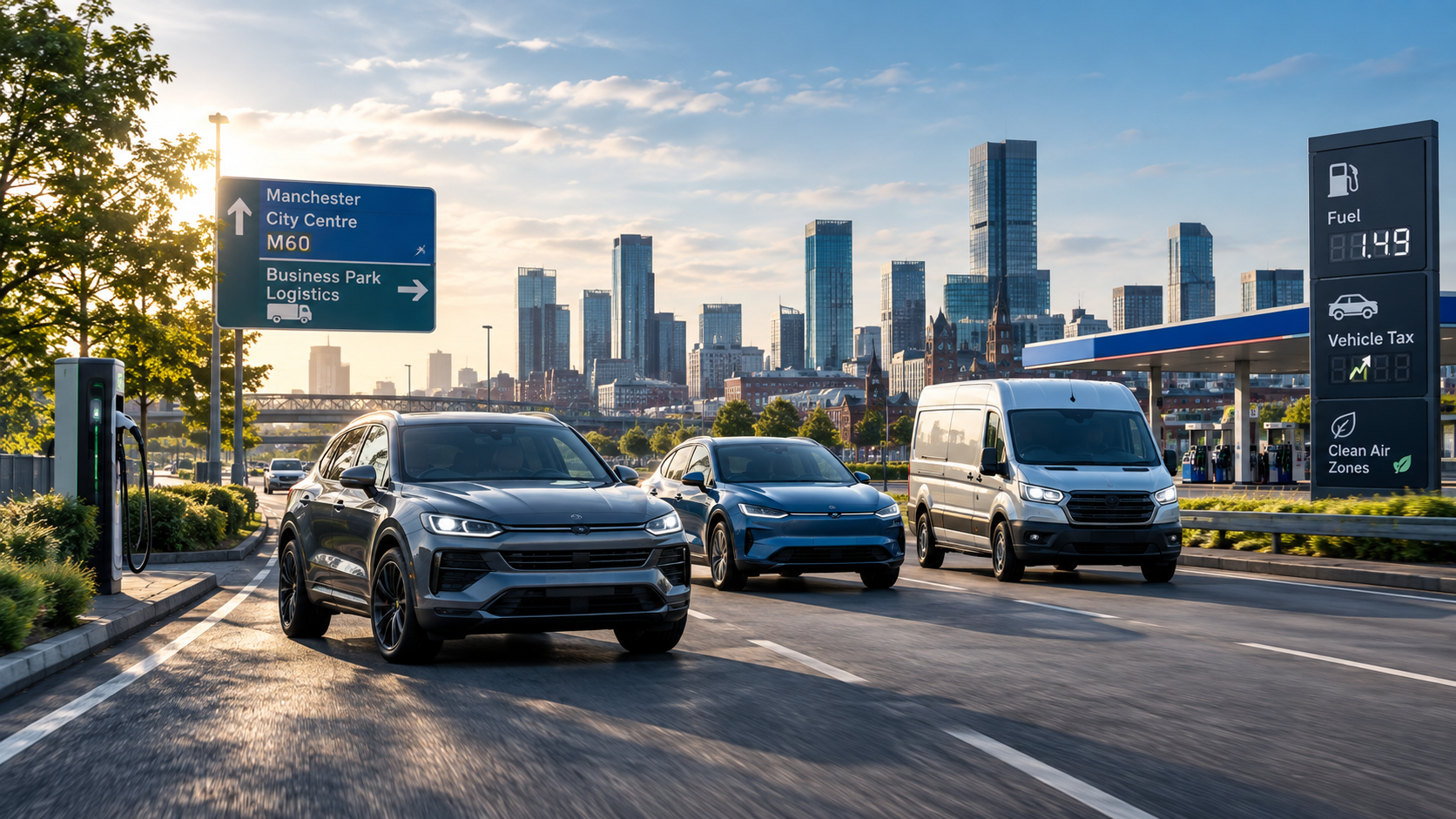
From vehicle tax and fuel duty to company cars and electric vehicles, the way UK businesses pay for and operate vehicles is changing For businesses that rely on cars and vans, the cost of keeping vehicles on the road has never been determined by the price on the windscreen alone. There is the cost of the vehicle.
Then there is:
- Finance
- Insurance
- Fuel
- Maintenance
- Tax
- Employee Benefit in Kind
And increasingly, the question of whether the vehicle will remain commercially viable as the UK's tax and transport system changes.
With Andy Burnham now Prime Minister, businesses are watching closely to see how his government's approach to motoring, taxation, energy and transport develops. Some changes are already in force. Others are scheduled for the coming years, while several areas — particularly fuel costs and future vehicle taxation -remain under review. For businesses operating one van, a company-car scheme or a fleet of dozens of vehicles, understanding these changes could make a significant difference to future vehicle costs.
So what is actually changing -and what could it mean for UK businesses?
Quick Answer: What Is Changing for UK Vehicles?
There are several vehicle-related developments businesses should be aware of:
- Electric vehicles are already subject to Vehicle Excise Duty.
- A new mileage-based Electric Vehicle Excise Duty (eVED) is scheduled from April 2028.
- Company-car Benefit in Kind rates are increasing gradually.
- Van Benefit in Kind charges have increased for the 2026/27 tax year.
- Car and van fuel-benefit charges have also increased.
- Benefit in Kind reporting is moving to mandatory real-time payroll reporting from April 2027.
- Fuel Duty is currently being phased back towards previous levels, although the government is considering whether further increases should be delayed.
- Greater Manchester's Clean Air Plan is investment-led rather than a charging Clean Air Zone.
- Businesses operating fleets need to consider how taxation, fuel, finance and vehicle choice interact.
The important point is that not all of these measures are new policies personally introduced by Andy Burnham. Several were announced before he became Prime Minister and are now being implemented or reviewed by his government.
Electric Vehicles Are No Longer Completely Free From Vehicle Tax
One of the biggest changes for businesses running electric vehicles is that EVs are no longer exempt from Vehicle Excise Duty.
Since 1 April 2025, electric and zero-emission vehicles have been brought into the VED system. For 2026/27, a new electric car registered on or after 1 April 2025 pays £10 for its first year and then the standard rate, currently £200. Electric cars registered between April 2017 and March 2025 also pay the standard £200 rate.
For businesses, this means the tax advantage of an EV needs to be considered as part of the wider cost of ownership rather than assuming an electric vehicle has no vehicle tax. But the bigger change is still to come.
Electric Vehicle Excise Duty Is Coming in 2028
From 1 April 2028, the government is scheduled to introduce Electric Vehicle Excise Duty, known as eVED. This will introduce a mileage-based charge for battery electric vehicles, plug-in hybrids and hydrogen-powered cars. For battery electric vehicles and hydrogen fuel-cell cars, the proposed rate is 3p per mile.
The government's stated reasoning is that petrol and diesel motorists currently contribute through Fuel Duty when they purchase fuel, whereas electric motorists do not pay an equivalent fuel duty.
As more vehicles become electric, Fuel Duty receipts are expected to fall. The new system is intended to create a mileage-based contribution from electric vehicles. What could this mean for businesses?
Mileage matters. A business vehicle covering 5,000 miles a year will obviously face a different eVED cost from one covering 30,000 miles. For fleet operators, that means the annual mileage of each vehicle could become an increasingly important part of vehicle selection. A vehicle isn't simply: “Electric or petrol?” It becomes: “What does this vehicle cost to acquire, finance, tax and operate over its entire lifecycle?”
Company Car Benefit in Kind Is Changing
Benefit in Kind is particularly important for businesses providing employees with company cars. The amount of tax an employee pays is generally calculated using the vehicle's taxable list price and an appropriate percentage based on factors including CO₂ emissions and fuel type.
For electric and low-emission vehicles, the percentage has been gradually increasing. For 2026/27, the appropriate percentage for zero-emission cars increases to 4%, up from 3% in 2025/26. For 2027/28, it is scheduled to increase again to 5%.
Petrol and diesel vehicles remain subject to substantially higher percentages depending on their emissions. This means company-car taxation is still structured to provide a significant tax distinction between lower-emission and higher-emission vehicles, but the gap is gradually changing.
Why Benefit in Kind Matters to Businesses
Benefit in Kind isn't simply an employee issue. For businesses operating company-car schemes, the tax position can influence: Which vehicles employees choose:
- The attractiveness of a company-car benefit
- Employer National Insurance costs
- Employee retention
- Recruitment packages
- Fleet emissions
- Vehicle replacement cycles
- The balance between EVs and combustion vehicles
A company choosing vehicles for employees therefore needs to consider more than the lease or finance payment.
The real calculation could be: Vehicle cost + finance/lease + employer costs + employee tax + running costs + future taxation.
That is particularly relevant for businesses reviewing their fleet over several years.
Van Benefit in Kind Has Also Increased
Cars aren't the only vehicles affected. For businesses providing company vans that are available for private use, the van Benefit in Kind charge increased from £4,020 to £4,170 for the 2026/27 tax year.
- This is particularly relevant to businesses where employees take commercial vehicles home. For example, tradespeople, engineers, maintenance teams and other mobile workers may use company vans as part of their employment package. The tax position therefore needs to be considered when deciding:
- Which vans employees receive
- Whether private use is permitted
- How the fleet is structured
- Whether electric vans are suitable
- Whether vehicles should be replaced
- What the overall employment cost will be
Fuel Benefit Is Changing Too
There is another consideration for businesses providing fuel for private use. For 2026/27:
- The car fuel benefit multiplier increased to £29,200.
- The van fuel benefit charge increased to £798.
- The van Benefit in Kind charge increased to £4,170.
For businesses providing company cars and fuel, this can increase the taxable value associated with the benefit.
It creates an important question for employers: Is providing private fuel still worthwhile?
For some employees, it may be. For others, paying for their own private fuel while the employer covers business mileage may produce a different tax outcome. The answer depends on the individual circumstances and the vehicle.
Benefit in Kind Reporting Is Also Becoming More Immediate
The changes aren't only about how much tax is paid. The way businesses report Benefit in Kind is changing too. From April 2027, employers will be required to report company cars, vans, car fuel and van fuel through payroll software and Real Time Information. This means businesses will no longer generally wait until the end of the tax year to report these benefits.
For businesses operating company vehicles, this means payroll, finance and fleet teams will need to ensure their systems contain accurate information. Vehicle changes, employee changes and benefit calculations will need to be managed correctly throughout the year.
For businesses with larger fleets, this makes accurate fleet records increasingly important.
What About Fuel Duty?
Fuel is one of the biggest costs for businesses operating commercial vehicles. The current Fuel Duty position is particularly important because the temporary 5p-per-litre cut has been extended until the end of 2026.
Under legislation already set out, rates were due to move back towards their pre-2022 levels through increases beginning in 2027. However, the Burnham government is now considering whether those planned increases should be delayed.
Burnham has said that his government is looking at measures to ease the cost of driving as diesel prices approach £2 per litre, but he has not committed to cancelling the planned fuel-duty increases. The issue is expected to be considered ahead of the October Budget.
For businesses, this uncertainty matters. A company operating ten diesel vans could spend thousands of pounds a year on fuel. A larger commercial fleet could spend considerably more. Even a few pence per litre can therefore have a noticeable impact on operating costs when multiplied across hundreds of thousands of miles.
Why Fuel Prices Matter More to Commercial Fleets
A private driver might fill their car once or twice a month. A commercial vehicle could be on the road every working day. A delivery van, engineering vehicle or trade van may cover tens of thousands of miles each year. This means fuel duty isn't simply a motoring issue for businesses. It is a cost-of-doing-business issue. Higher fuel costs can affect:
- Delivery costs
- Call-out costs
- Operating margins
- Product pricing
- Employee travel costs
- Fleet budgets
- Vehicle selection
For businesses with high annual mileage, fuel efficiency can therefore become just as important as the initial purchase price.
What About Congestion Charges?
This is an area where there is often confusion around Andy Burnham and vehicle policy. Greater Manchester has previously considered charging measures as part of its Clean Air Plan, but the current plan is an investment-led, non-charging Clean Air Plan.
The government confirmed that Greater Manchester would not need to implement a charging Clean Air Zone under the approved plan. That means businesses operating in Greater Manchester should not currently assume they will face a general Manchester-style congestion charge simply because of Burnham's transport policies.
Instead, Greater Manchester's approach has included investment in cleaner buses, traffic management and support for cleaner vehicles. The distinction is important: Clean-air measures are not automatically the same thing as a congestion charge.
Greater Manchester Is Still Changing How People Travel
Although there isn't currently a general congestion charge, Greater Manchester continues to pursue policies designed to reduce congestion and encourage alternatives to private car use. The region has invested heavily in the Bee Network, public transport and active travel.
There are also plans to expand School Streets, which can restrict vehicle access around schools at certain times, with an ambition for 100 permanent School Streets by April 2028.
For businesses operating vehicles in Greater Manchester, this means the local transport environment can change even without a conventional congestion charge. Businesses should therefore consider how vehicles access customers, depots, city centres and other restricted areas.
What Does All This Mean for Businesses?
Put all of these changes together and the vehicle-cost calculation becomes increasingly complicated. A business looking at a new vehicle might previously have focused on: Purchase price + finance + fuel.
Today, it needs to consider much more. The modern fleet calculation could include:
- Vehicle price - How much does the vehicle cost?
- Finance - What will it cost to fund?
- Vehicle tax - What VED applies now — and what could apply later?
- Fuel - How much will the vehicle cost to operate?
- Benefit in Kind - What tax will the employee and employer face?
- Mileage - How many miles will the vehicle cover?
- Maintenance - What will servicing and repairs cost?
- Downtime - What happens if the vehicle is off the road?
- Depreciation - How much value will the vehicle lose?
- Resale - What could it be worth when the business replaces it?
This is the total cost of ownership.
Could These Changes Affect Fleet Decisions?
Absolutely. Businesses that are due to replace vehicles over the next three to five years may need to think differently about their fleet strategy. For example, a business considering a diesel van may need to compare its fuel and tax position against an electric alternative.
But an electric vehicle isn't automatically the right answer either. Businesses need to consider:
- Annual mileage
- Charging availability
- Daily operating range
- Payload
- Vehicle downtime
- Finance cost
- Tax
- Driver requirements
- Resale value
- Operational practicality
For a business covering 10,000 miles a year with access to charging, an EV may look very different financially from an EV covering 40,000 miles a year without reliable charging infrastructure. The right vehicle depends on how the business actually operates.
This Makes Vehicle Sourcing More Important
As vehicle taxation becomes more complicated, businesses can benefit from looking beyond simply finding a vehicle at the lowest purchase price. A professional vehicle sourcing service can assess the market based on the business's actual requirements. That could mean identifying:
- New commercial vehicles
- Used vans
- Electric vans
- Diesel vans
- Company cars
- Prestige vehicles
- Fleet vehicles
- Finance options
- Vehicles with strong residual values
The objective is not simply: “Find me a van.” It is: “Find me the right van for the way my business operates and the costs I need to manage.”
What Should Businesses Do Now?
Businesses don't necessarily need to make dramatic changes overnight. But they should understand how their current fleet is positioned.
- Review your fleet - Understand the age, mileage, fuel type and running costs of every vehicle.
- Review your finance - Look at when vehicles come to the end of their agreements and what replacement costs could look like.
- Review Benefit in Kind - If employees receive company cars or vans, understand how the current and future tax treatment affects both the employee and employer.
- Monitor fuel expenditure - Fuel can be one of the largest variable costs for commercial fleets.
- Consider future taxation - Don't make a three- or four-year vehicle decision based solely on today's tax position.
- Calculate total cost of ownership - Purchase price is only one part of the equation.
- Plan vehicle replacements - Avoid being forced into a rushed vehicle purchase because an existing vehicle suddenly becomes uneconomical or unreliable.
The Bigger Question: What Will a Vehicle Cost Your Business in Five Years?. This may ultimately be the most important question.
A vehicle purchased today could still be on the road several years from now. During that period, businesses could see changes to:
- Vehicle taxation
- Fuel duty
- Electric vehicle taxation
- Benefit in Kind
- Emissions policy
- Charging infrastructure
- Finance costs
- Insurance
- Fuel prices
This makes long-term vehicle planning increasingly important. The cheapest vehicle to acquire today isn't necessarily the cheapest vehicle to operate over five years.
Find & Finance: Helping Businesses Navigate Changing Vehicle Costs
At Find & Finance, we understand that businesses don't simply need vehicles. They need vehicles that work financially and operationally for the business. Our Commercial service can help businesses source vehicles based on their specific requirements, arrange finance and carry out the necessary checks before the vehicle reaches the business. And our approach doesn't stop once the vehicle has been delivered. Through Fully Managed Motoring, we can continue supporting businesses with:
- Vehicle sourcing
- Commercial vehicle finance
- Vehicle inspections
- Preparation
- Nationwide delivery
- Servicing
- MOTs
- Repairs
- Bodywork
- Warranty claims
- Vehicle replacement
- Resale
That means businesses can have one relationship supporting the vehicle throughout its lifecycle.
Final Thoughts
The UK's vehicle taxation landscape is becoming more complicated. Electric vehicles are now subject to VED, with a mileage-based eVED charge scheduled from April 2028. Company-car Benefit in Kind rates are changing. Van Benefit in Kind and fuel-benefit charges have increased. Benefit in Kind reporting is moving into real-time payroll. Fuel Duty remains under pressure as fuel prices rise. And businesses operating in areas such as Greater Manchester also need to keep track of local transport and clean-air measures.
Not every one of these changes is an Andy Burnham policy -several were already legislated before his government took office. But his government will now determine how some of these policies develop, particularly around fuel costs and the wider cost of motoring. For businesses, the message is straightforward: Don't just look at the price of the vehicle. Look at the cost of running it, financing it, taxing it and eventually replacing it. Because as vehicle taxation evolves, choosing the right vehicle could become just as important as negotiating the right price.
Need Help With Your Business Vehicles?
Whether you need one van for a growing business or are managing a larger commercial fleet, Find & Finance can help you source, finance and manage your vehicles. From finding the right vehicle to looking after it throughout its lifecycle, our Fully Managed Motoring approach means you're never left alone.
Call: 0333 006 3825
Email: sales@findandfinance.co.uk
Website: www.findandfinance.co.uk
Stay ahead of the latest automotive news, vehicle buying advice and market insights by subscribing to our newsletter here